
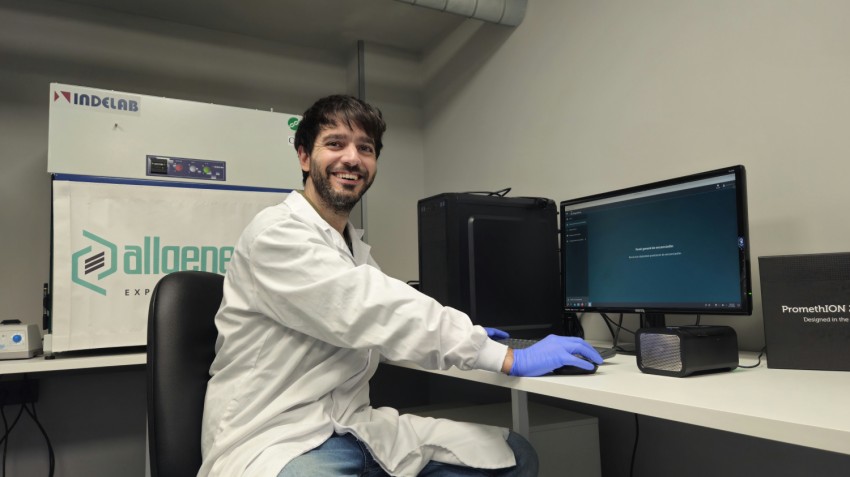
Discover the potential of long-read DNA metabarcoding with Oxford Nanopore technology, combining full-length barcode analysis, enhanced taxonomic resolution, and real-time sequencing for faster data generation.
By Dr Verónica Rojo
DNA metabarcoding has become an essential tool for identifying species and characterising complex biological communities across a wide range of research and industrial applications. At AllGenetics, we have incorporated the latest advances in Oxford Nanopore Technologies (ONT) sequencing into our DNA metabarcoding services, offering a powerful alternative to conventional short-read technologies such as Illumina.
One of the main advantages of Nanopore sequencing is its ability to generate long reads, allowing the analysis of full-length DNA barcode regions, such as the V1–V9 regions of the 16S rRNA gene or the entire ITS region. Compared with the shorter DNA fragments typically analysed using Illumina sequencing, these longer sequences provide more taxonomic information, which can improve species identification and the discrimination of closely related taxa. Furthermore, Nanopore enables real-time sequencing, allowing faster data generation and potentially shorter turnaround times.
These advantages make Nanopore metabarcoding particularly valuable in the food and agri-food industries, where it can be used for rapid species authentication, ingredient traceability, quality control, and the detection of adulteration or contamination. Other key applications include timely pathogen detection and surveillance in food, agricultural, and environmental samples. The improved taxonomic resolution offered by long-read sequencing is particularly beneficial for microbial community profiling and monitoring in biotechnological processes such as fermentation, wastewater treatment, and bioremediation, as well as for biodiversity assessments and environmental research.
However, obtaining reliable results from Nanopore metabarcoding requires much more than simply generating long sequencing reads. Despite continuous improvements in sequencing chemistry and accuracy, careful optimisation of laboratory protocols and bioinformatics analyses remains essential to minimise methodological biases and ensure accurate taxonomic assignments.
At AllGenetics, we have invested considerable effort in developing and validating our Nanopore metabarcoding workflows through rigorous testing of different PCR protocols, library preparation methods, and bioinformatics pipelines. Our validation includes extensive benchmarking experiments using complex mock communities of known composition, sequenced in parallel on Illumina and Nanopore platforms to compare performance, identify potential sources of error, and optimise our analytical procedures. Our bioinformatics pipeline also incorporates dedicated steps to detect and mitigate frequently overlooked artefacts such as mistagging, traditionally associated with Illumina but also a significant concern in Nanopore sequencing.
Building on this extensive validation work, and continuously incorporating the latest developments in Nanopore sequencing technology, we provide a complete end-to-end DNA metabarcoding service, covering every stage of the workflow, from DNA extraction and library preparation to sequencing and bioinformatics analysis.
At AllGenetics, we understand that every project has its own scientific objectives and technical requirements. Rather than offering a one-size-fits-all solution, we help our clients choose between Nanopore and Illumina sequencing, taking into account their target organisms, genetic markers, and required taxonomic resolution.
Planning a DNA metabarcoding project? Get in touch with our sales team to discuss your ideas and explore the most suitable options for your research. Our scientific experts will support you throughout the project, from experimental design to data interpretation.